
How to Search Criminal Dockets
Kansas CaseSearch is the portal where a state criminal docket search starts. Pick Wabaunsee County, then pick Criminal. A full case number works best as a search key. If you lack one, other routes in exist. Party Name, Business Name, Party As Business Name, and Citation Number are the alternatives. Filing dates can narrow the results. Expect a human verification step before the portal shows anything. Use the source notice to confirm the court before relying on an entry.
- Choose the district search and Wabaunsee County.
- Enter the full number, or a name and date range.
- Match county, filing date, type, and party role.
- Read events from the first filing to the latest entry.
- Confirm a key result with the judgment or clerk.
The Wabaunsee County District Court clerk sits at 215 Kansas Avenue, third floor, Alma, Kansas 66401. Call 785-765-2406 for help with a docket request.
Wabaunsee Criminal Dockets Start in District Court
State felony and misdemeanor cases filed in Wabaunsee County belong to Kansas District Court. A district magistrate judge may handle a stage of the case. That does not create a second records office, because the unified Clerk of the District Court keeps the county file for every Wabaunsee County criminal docket.
Quick answer: Search a felony under Wabaunsee County in CaseSearch. Take a city ordinance charge to the municipal court named on the citation.
Alma, Alta Vista, Eskridge, Maple Hill, and Paxico each run their own municipal reporting courts, separate from the district system. A blank county result may simply mean the record sits in a city court docket rather than nowhere at all.
What a Criminal Docket Shows
Think of a Wabaunsee County criminal events index as a chronology, not the whole case file. A current case number may look like WB-2024-CR-000001, while older files follow earlier formats.
| Header | Number, county, type, filing date, status, and judge when public. |
|---|---|
| Charge | Count, offense, statute, class, and amendment. A charge is not a conviction. |
| Settings | Date, time, judge, room, and event type. |
| Chronology | Filings, motions, orders, hearings, pleas, and payment events. |
| Outcome | Diversion, dismissal, plea, acquittal, conviction, sentence, or appeal. |
| Documents | Public complaints, orders, and judgments when web access permits. |
An event label alone is never the full ruling. When exact proof matters, read the filed order or ask the clerk for the named document behind the docket entry.
Wabaunsee Criminal Docket Workload
The fiscal year 2024 report offers scale for the criminal docket without describing any one person. It covers the fiscal year that ended June 30, 2024. New filings and pending matters measure different things, so read each figure for what it counts.
The same table lists 62 pending felony cases and 90 pending misdemeanor cases. Its over-twelve-month columns report 59.7 percent for pending felonies and 81.1 percent for pending misdemeanors. Those percentages describe aggregate statewide inventory in the report. They say nothing about a particular Wabaunsee County criminal case: how long it has been open, why it is still pending, or when its next hearing will occur. For that, read the case docket itself.
Stages on a Criminal Docket
A Wabaunsee County criminal docket often opens with a complaint, information, or indictment. First appearance or arraignment comes next. Bond, release, or warrant events may follow, along with motions, status dates, and continuances. A listed trial is only a setting. A later entry shows what actually happened in court.
Docket flow: Filing › Arraignment › Pretrial › Plea or Trial › Disposition › Sentencing.
Restitution, costs, review, satisfaction, expungement, or appeal can all appear later on the docket. An appeal adds a second docket layer, so keep the district and appellate chronologies separate when you track a Wabaunsee County case.
Wabaunsee Criminal Docket Settings
Arraignment, pretrial, motion, trial, sentencing, and review are distinct settings, and each does different work. An arraignment addresses the charge and the plea under the governing procedure. A pretrial or status conference can take up motions, discovery, readiness, or scheduling. A motion hearing concerns only the motion named in the notice or docket entry. Trial and sentencing come at later stages. A scheduled event is not proof it was held. Search past the listed date for a continuance, reset, cancellation, order, or later setting. Never assume anything before that check. A "plea setting" also does not prove a plea was entered. Wabaunsee County posts no general daily criminal calendar feed. Current case events and clerk confirmation matter most when an appearance is near. Write down the date, time, event label, judge, room, and appearance method exactly as shown. If two entries conflict, the later filed notice or order is usually the better lead. The clerk should confirm the operative setting.
Wabaunsee Criminal Docket Dispositions
The fiscal year 2025 report lists 58 felony and 62 misdemeanor dispositions. Those are broad report classes, not substitutes for judgments in a Wabaunsee County criminal case. Annual totals simply count court activity across a reporting period. They cannot tell you whether a named case ended. They cannot say whether a charge changed or whether later review occurred.
- Diversion
- A conditional route whose terms and completion may be separate.
- Dismissal
- An end recorded by the court; the order controls its effect.
- Guilty plea
- A plea result followed by the operative judgment and sentence.
- Acquittal
- A not-guilty result after trial.
- Other
- A statistical bucket, not a local legal conclusion.
Read charge, result, and sentence as three separate things. A plea setting does not prove a plea occurred. An original charge label, likewise, does not always state the final offense. Follow amendments, plea entries, verdicts, journal entries, and sentencing events in order across the docket. When the outcome matters for an active obligation, request the filed order or judgment. Confirm its current status with the Wabaunsee clerk.
Which Court Holds Criminal Dockets
Wabaunsee District Court holds the state felony and misdemeanor files for the county. Municipal courts keep city ordinance and municipal traffic dockets. Later review records sit with the Kansas appellate courts.
| Case | Custodian | Route |
|---|---|---|
| State crime | District Court Clerk | CaseSearch, terminal, clerk |
| City ordinance | Municipal court | City clerk |
| Appeal | Appellate court | Appellate CaseSearch |
The municipal jurisdiction law backs up this city and district split. Appeals from municipal court move into the district system. Yet the original city record keeps its own custodian. A notice may touch both levels. Ask which docket holds the event or order you need. That one question saves you a hunt through the appellate layer for a municipal filing that never traveled with the appeal record.
Wabaunsee Criminal Docket Terminal Access
Remote and courthouse access are two different things, and the Smart Search guide spells out the split. The terminal can be the richer view. Older material and converted public documents sometimes appear there even when no web image exists. So an entry without a clickable image may still point to a public paper that has to be viewed another way.
Bring the case number, name, year, and document date. Ask for a permitted events index or a named item, and say up front whether a plain or certified copy will do. A narrow request helps staff find the right complaint, order, judgment, or journal entry, and it lets the clerk judge whether redaction applies. Sensitive details stay out. A Social Security number, full birth date, driver-license number, and payment data do not belong in an open request.
No per-page price is posted. No fixed turnaround appears either. Mail goes to P.O. Box 278. The fax line is 785-765-2487, though the court does not say whether faxed requests are accepted. A south drop box takes criminal paperwork and payments, so confirm receipt. Ask about fees and delivery before sending funds. A transcript comes through a court-reporting process and is not the same product as a clerk copy.
Wabaunsee Criminal Charges Are Allegations
A charge block lists what the public may see: the count, the offense description, the statute, and the classification, and it can also note an amendment. None of that settles guilt. A charge is an accusation, nothing more. The real outcome shows up later in the Wabaunsee County criminal docket, usually as a plea, dismissal, verdict, judgment, or sentencing entry.
Read the record in three passes. Start with the complaint, information, or indictment when it is public. Then trace each amendment and disposition event. Finish with the filed judgment or journal entry. A short CaseSearch label will not always repeat every term in the signed order. FY 2025 statistics back this up, splitting Wabaunsee felony and misdemeanor dispositions among diversion, dismissal, guilty plea, trial, and "other." Never turn a charge into a conviction. Treat the broad "other" bucket as a category, not a case-specific result.
Public Access and Sealed Criminal Dockets
A public header can mask hidden papers. An affidavit, presentence report, or warrant paper may stay out of view anyway. The reasons are not the same. Juvenile, expunged, sealed, and redacted records each answer to distinct rules. A blank result may reflect a city case, an older file, a restricted type, or the portal gate. Sealing limits access by court order. Redaction masks protected fields. Expungement follows its own statute.
Key rules:
Rule 22 defines public access levels and excluded records.
Rule 24 protects personal identifiers in filings.
K.S.A. 60-2617 governs sealing and public-interest balancing.
The clerk can name the lawful route but cannot release nonpublic material. A terminal does not override a seal. When a public result looks thin, ask for the specific permitted record. Do not demand every item in the file. Access may require a written request, a court order, or proof of authorized status. The clerk can explain which step applies.
Wabaunsee Criminal Warrant Document Limits
Seeing a warrant or bond event does not mean every related document opens online. Kansas Supreme Court Rule 22 bars categories that include unexecuted warrants, search warrants, and probable-cause affidavits. The public events index can still list a permitted event or status while the supporting image stays back. That gap is an access rule. It is not proof that CaseSearch lost the filing.
Bond detail comes in layers too. A public entry may show an amount, type, release event, forfeiture, or later review. The full terms can live in a separate order. Read the later entries before assuming anything. The first bond event may not still stand. When a document is not displayed remotely, ask the Wabaunsee clerk whether a permitted version can be inspected at the courthouse terminal or copied. The clerk cannot override a statutory limit or court order. Keep protected identifiers out of email, fax, or any broad written request.
Wabaunsee Criminal Docket CaseSearch Entry
The official CaseSearch gateway carries permitted Wabaunsee County district case information. The statewide interface that comes next is that official site.
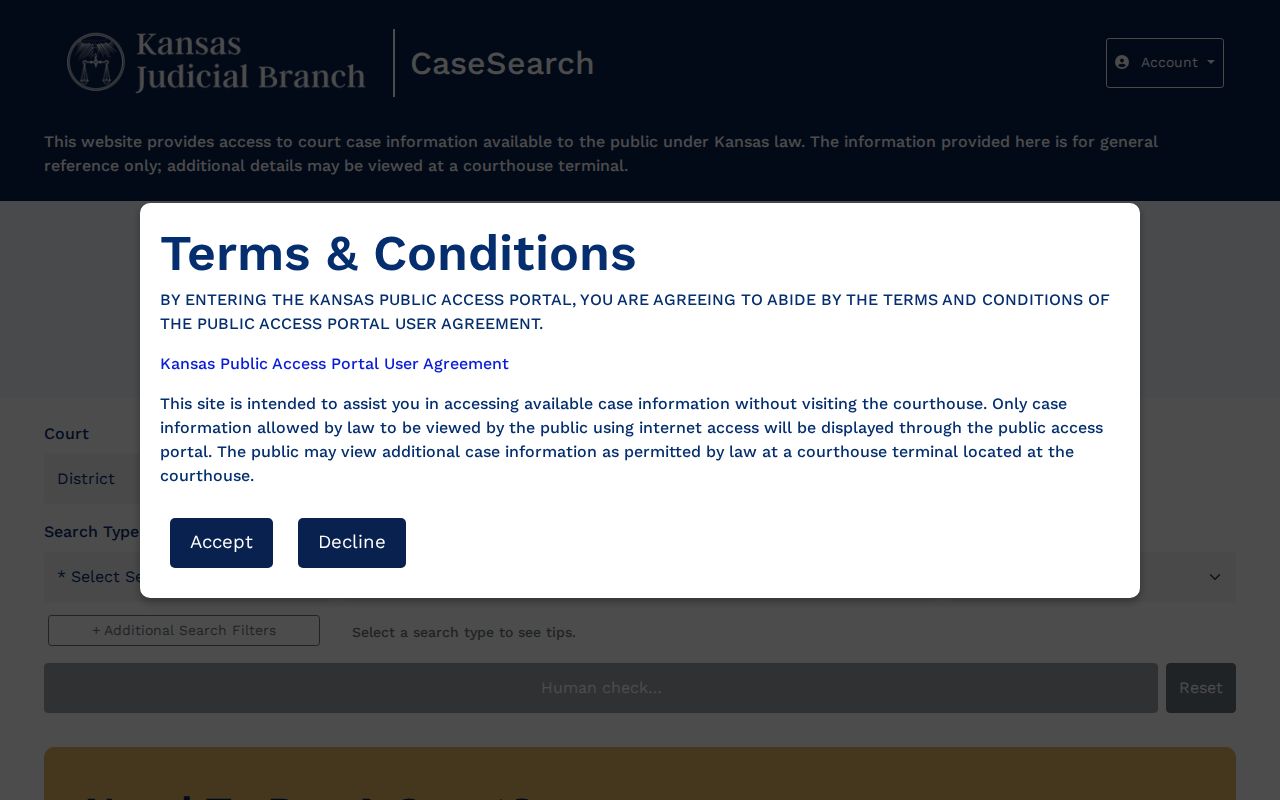
The official page shows the statewide interface with its verification step. Narrow it to Wabaunsee County and Criminal. Check the case number character by character before falling back on a name search. Some names are common. Compare the filed date, case type, county, and party role instead of collecting private identifiers.
The Central Payment Center can locate an eligible balance. But a payment result is not the criminal events index. It shows no motion, setting, order, or disposition. Use the court docket for chronology. Turn to the clerk for an official judgment, satisfaction, or certified copy.